

A friend said something to me recently that I keep thinking about.
“I have three customers. I think it’s time to raise money.”
I understood the excitement; landing real customers is a real milestone. But I asked a few clarifying questions. How many customers, exactly? What’s actually driving the decision to raise right now?
The answers were not concrete and instead seemed to cover up the real reasons.
Veterans of venture capital will tell you that fundraising is a tool to help your business meet its goals. It is not the goal itself. So why does it keep feeling like the main event?
Three patterns keep showing up when I dig into this with founders — and one of them rarely gets named.
Three patterns that push founders to raise too early
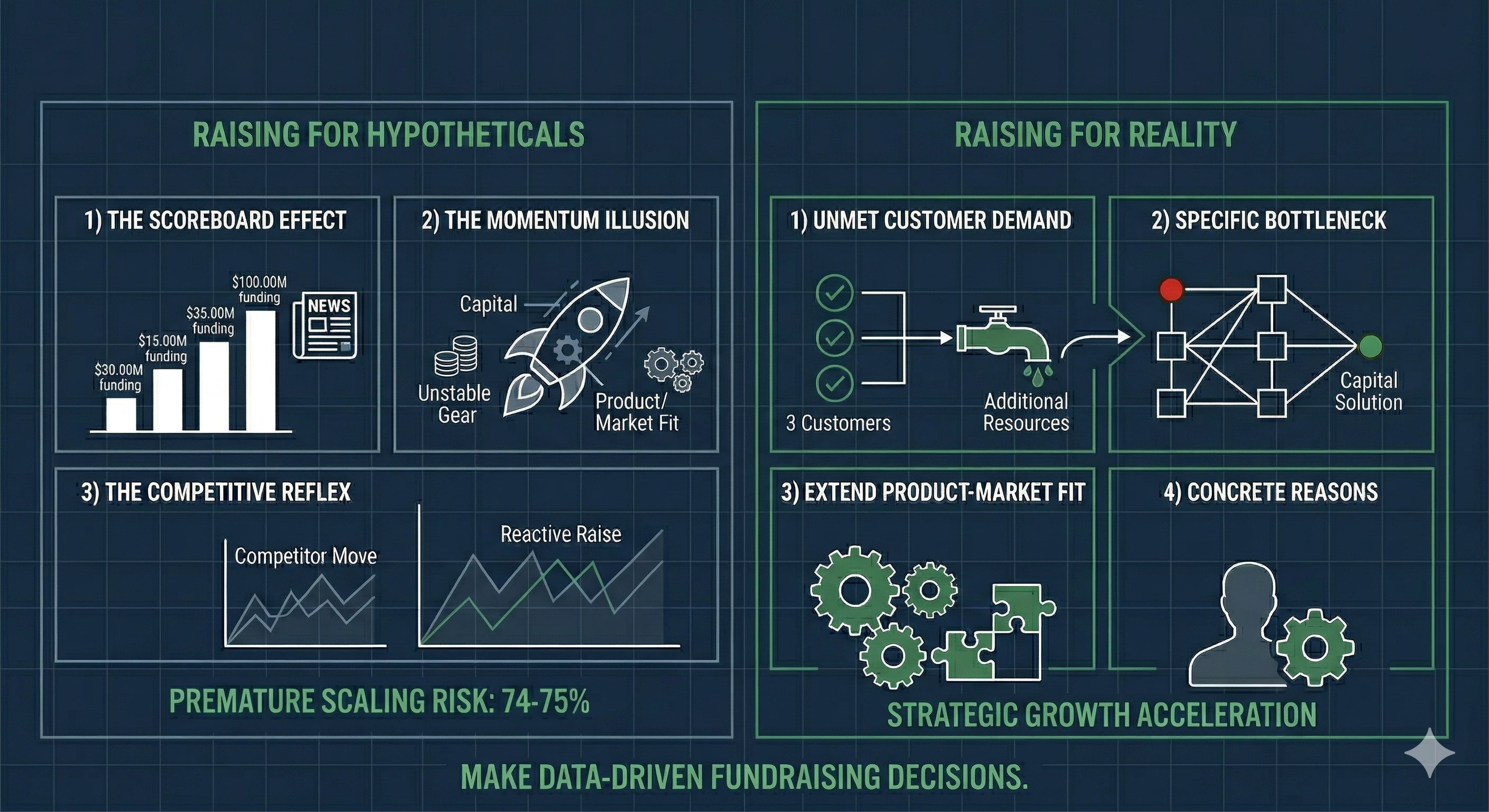
The scoreboard effect
Headlines about round sizes make it easy to treat fundraising as a metric. When peers announce raises, it can feel like you’re falling behind — even when your business is on a completely different trajectory that doesn’t need outside capital yet.
The momentum illusion
Raising a round feels like forward motion. Sometimes it is. But often, the real motion is solving a product, distribution, or demand problem — and capital doesn’t fix those. It accelerates them, in both directions.
The competitive reflex
When someone in your market raises, the instinct is to match it. That instinct is understandable. It’s also not a fundraising strategy.
What makes these patterns dangerous isn’t that they’re irrational. It’s that they’re contagious. And the data makes clear where that contagion leads.
Let’s look at what actually happens when founders raise before they’re ready.
What the data actually shows
75% of venture-backed startups fail to return a single dollar to their investors — often because they scaled before solving for real customer demand. (Harvard Business School)
74% of high-growth startup failures in US tech resulted not from a lack of funding, but from spending raised capital on rapid scaling before the company had product-market fit. (World Metrics / Duet Partners)
If raising as early and largely as possible were the ideal strategy, the failure rates would not be this consistent. There is a pattern here, and it has a name.
That name is Blitzscaling — and most founders are misapplying it.
Why Blitzscaling isn’t what most founders think it is
Blitzscaling is the deliberate prioritization of speed over efficiency in markets where coming in second means losing everything. Reid Hoffman’s book of the same title described the logic bluntly: “Grow Fast or Die Slow.”
In true winner-take-all markets (where network effects allow one dominant player to capture nearly all industry value) the strategy is rational. Timing matters more than efficiency.
The problem isn’t the strategy itself. It’s that those markets are rare, almost exclusively in tech, and most founders aren’t in one. Walking into an investor meeting with a Blitzscaling pitch for a business that doesn’t operate in a winner-take-all dynamic won’t accelerate your raise. It will end it.
This isn’t strategy. This is letting peer pressure guide your fundraising decisions.
Which brings us to the conversation that actually started this post.
What peer pressure actually sounds like
A client came to me earlier this year. Here’s roughly how it went:
Client: “Jake, I want to do my Series Seed now.”
Jake: “That’s great. Did you just get a big order you need capital to fill?”
Client: “Well, no.”
Jake: “Do you need to hire to increase production speed?”
Client: “Not really.”
Jake: “We already talked about not raising as fast as possible just to raise. So what’s driving this?”
Client: “I saw headlines about [competitor]’s raise. Our product is better — so we should do it too.”
That’s not strategy. That’s a scoreboard.
So when does it actually make sense?
Three reasons investors actually get behind
You have clear customer demand you cannot meet without additional resources, and capital would help you scale into that demand.
You have found product-market fit and need to extend your product, or you need capital to build your first version in a capital-intensive category.
You are facing a specific bottleneck — a key hire, a production constraint, a market window — that capital can clearly and directly solve.
There are good reasons to raise capital. Peer pressure is not one of them.
Raising money isn’t the finish line. Building something people actually want is.
Once you’ve done that — once you have demand you can’t meet, a fit you’re ready to extend, or a specific constraint capital can solve — the conversation with counsel changes entirely.
Then you can walk into that meeting and say, with real conviction:
“I think it’s time to raise money.”
Ask yourself: which of the three pressure patterns above is influencing your thinking right now? Name it — and then decide.