

Most people see disability and assume fragility.
My life has taught me the opposite.
A Personal Note for Cerebral Palsy Awareness Month
March is National Cerebral Palsy Awareness Month.
So, I’m taking a break from my usual venture capital ramblings to talk about how CP has molded my life. I’ll share some thoughts, a few lessons learned, and hopefully some useful advice for anyone living with a disability or supporting someone who is.
What’s my goal? Of course, raising awareness and maybe inspiring someone would be great. But honestly, I just want to make it less awkward to talk about disabilities, share what I’ve learned, and hopefully do my part to shatter a few stereotypes along the way.
Breaking the Stereotypes
Let’s talk about a few stereotypes that just won’t seem to go away about physical disabilities. You’ve probably heard them before.
First up: the Fragility Myth. People see a physical disability and instantly think it means physical weakness.
Second, there’s the idea of the Passive Recipient. The assumption here is that people with disabilities have to sit around and wait for help, instead of having the agency to build a life that works for them.
And third, the Lowered Ceiling. This is the loud-but-unspoken expectation that if you have a disability, just getting by is the best you can hope for, rather than mastery.
The Strenuous Life
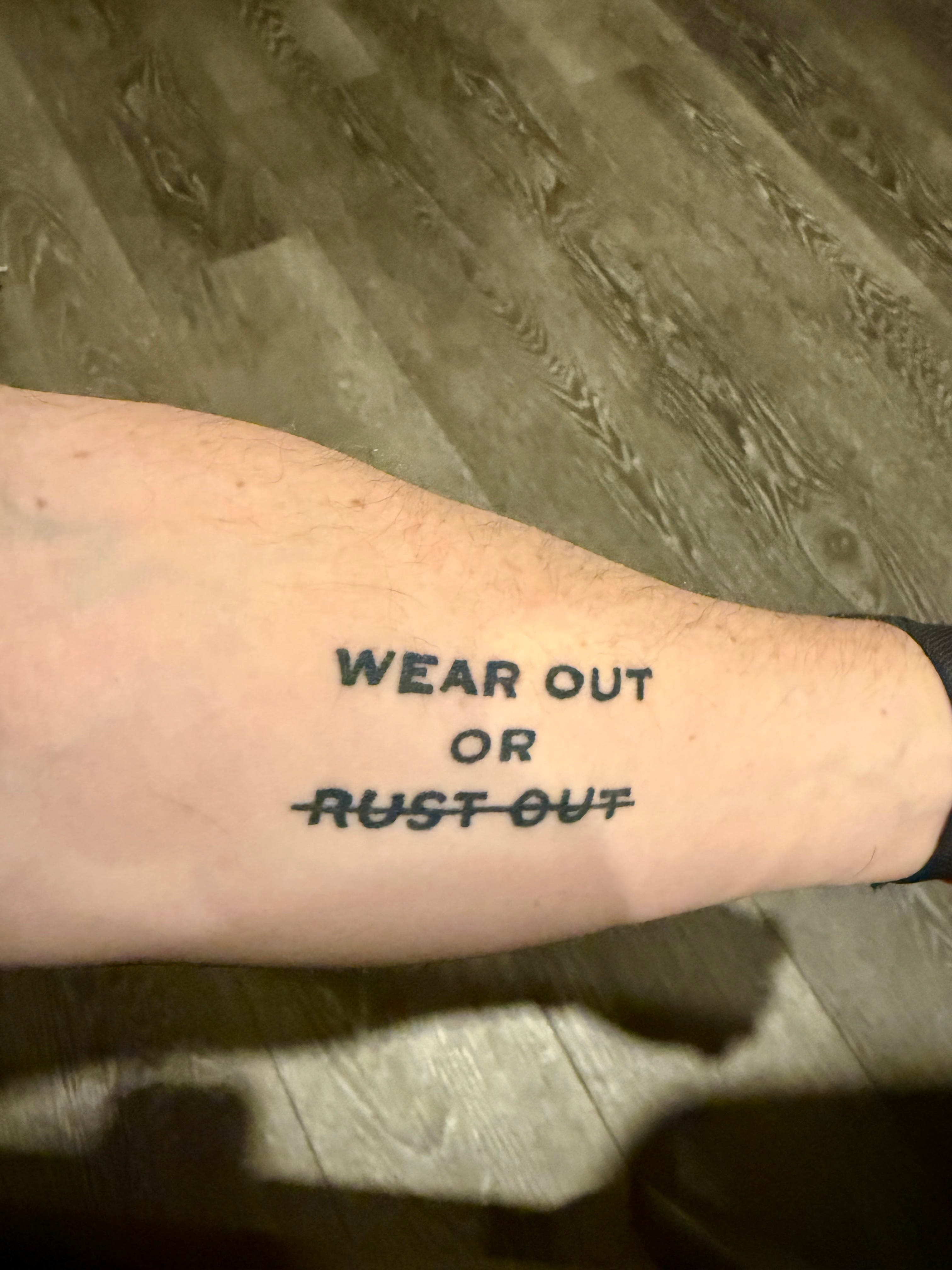
If you want to know my life philosophy, I actually carry a reminder of it on my arm:
Wear Out or Rust Out.
That phrase comes from Theodore Roosevelt. His approach to life taught me you don’t have to accept the stereotypes other people try to stick on you.
Most people remember Roosevelt as the Rough Rider or the face on Mount Rushmore.
However, he wasn’t born a mountain of a man. He started out as a frail, asthmatic kid who struggled just to breathe.
His father once told him that he had the mind but not the body, and that without the body, the mind could never reach its full potential. The solution was simple but demanding: he would have to make his body.
Roosevelt didn’t avoid physical activity (AKA, buy into the fragility myth), accept whatever life gave him (AKA be the passive recepient), or accept that he would never live up to the already legendary Roosevelt name because of how he was born (AKA giving into the lowered celing) He built his health, life, and legacy, with the help of his family and through hard work..
As a kid, Teddy’s family built a small gym in their New York home. He spent years climbing pegboards and hanging from bars, slowly turning himself into the living example of what he later called the strenuous life.
Bringing The Body to The Mind
Breaking the Fragility Myth
Too often, popular culture paints disabled people as fragile, like we’re all just one bump away from breaking. It’s as if we’re all versions of “Mr. Glass,” rolling or walking through the world.
Believe it or not, even some people whose job is to help those with disabilities buy into this idea.
Growing up and even now, many therapists and trainers just wanted me to “get by.” For a while, I assumed that was how things were supposed to be.
Then I read Theodore Rex and learned Roosevelt’s story. That’s when I realized that just like him, I had the chance to work on my body every single day.
So I started looking for therapists and trainers who would push me harder than their other clients. People who wouldn’t give me permission to make excuses.
Eventually, I realized I wasn’t fragile and that hard physical activity wouldn’t break me.
Instead of sitting back and rusting out, I was choosing to wear out.
Instead of sitting back and rusting out, I was choosing to wear out.
If you have a disability (or someone in your life does), I encourage you to find your own life mantra. The world isn’t always easy for people with disabilities, so you need something to guide you through the tough days.
For me, it’s “wear out, not rust out,” but here are a few others worth considering:
Progress, not perfection.
Adapt, don’t quit.
Lead with what you CAN do.
Along with a mantra, a daily routine can also help.
Maybe that’s setting a goal to walk or wheel a certain distance, closing your Apple Watch rings, keeping a gratitude journal, or even just spending 10 minutes each morning thinking about what you want to accomplish.
These small habits add up and help shift your mindset over time, and reinforce that mantra. The important thing is to pick something that actually means something to you and slowly but surely gets you to push your limits.
But physical strength was only the first stereotype I had to break.
Agency
Breaking the Myth of the Passive Recipient
Moving beyond physical strength, let’s consider the myth of passivity and lack of agency.
For me, this stereotype wasn’t as much about what others thought. Regretfully, it was something I struggled with on the inside.
As may be shocking for those who know me, one of the hardest things I’ve had to learn as someone with a disability is having the courage to ask for what I need.
Maybe it was feeling like I should just be grateful for the help I already got, or maybe it was the fear of hearing “no.”
I struggled with this well into my twenties, until I came across some posts from other people with disabilities.
Reading those posts led me to a “duh” realization: everyone’s disability looks different, and nobody else can see your day-to-day challenges. Most people want to help, but it’s up to you to ask for what you need.
Everyone’s disability looks different, and nobody else can see your day-to-day challenges.
This realization made my life immeasurably easier, and while I am not one to regret the past, I do catch myself thinking about how much easier my life would have been had I developed this sense of agency sooner.
I would have chosen to live in an apartment that was actually handicapped-accessible, instead of thinking, “This is the best I can do.”
I would have asked for a different model wheelchair when the one I originally had did not fit my lifestyle.
I would have told my physical therapists they weren’t pushing me as hard as I wanted.
If you know someone with a disability, please do whatever you can to help them build a sense of agency. It doesn’t happen overnight, but even gradual improvement will get them there. Encourage them to speak up about what they need, set boundaries, and make their own choices in everyday situations. Help them set related goals, such as asking for a classroom accommodation or handling a routine task independently. Celebrate every bit of progress, no matter how small; it can have an outsized impact on their future.
You CAN Do That
Breaking the Stereotype of the Lowered Ceiling
Just like the lack of agency, the idea of a lowered ceiling for people with disabilities didn’t really become visible to me later in life.
However, this stereotype was purely external.
Growing up, my adoptive parents were always my biggest cheerleaders. They backed every crazy idea I had—cartoonist, comedian, author, football coach, venture lawyer, Shark Tank investor, you name it.
Sure, my disability made some parts of those careers harder. But my parents never said, “disabled people can’t do that.” Instead, it was always:
“That’s great! Let’s figure out how you can do it.”
As I grew up and moved into adulthood, I assumed that this was how everyone operated around people with disabilities. Encouraging, supporting, and helping them figure out their path.
In my first few entry-level jobs, nothing I saw made me think otherwise.
But once I started practicing as a venture lawyer, that view got shattered.
Initially, when I would tell people where I worked, and they would come back with “as a lawyer?” I was extremely confused. “Well, yeah, as a lawyer. Most people who work at law firms are, in fact, lawyers.”
It wasn’t until I talked with a friend about why this kept happening that it finally clicked:
There is a stereotype that disabled people can’t have jobs like mine.
That insight struck me like an overhand right that I never saw coming. Maybe people assume there’s a mental impairment, too, or maybe it’s just ignorance.
Either way, this is actually the easiest stereotype to disprove.
I highlight my disability and my career as a way to both break this stereotype and to show people like me that it is possible to do what you want to do in life, regardless of others’ expectations.
If you know someone facing these same issues, here’s what I’d suggest: First, follow my parents’ lead and ask, “How can we make this happen?” instead of “That’s not for you.” Second, help them find role models in similar situations. Third, talk openly about the lowered ceiling stereotype so they’re ready to push back against it.
Conclusion
It’s easy to let the world’s stories become our own: that physical challenges mean mental weakness, that people with disabilities are bystanders, or that just getting by is enough.
But none of these are facts. They’re just barriers, and every day, we get a chance to break them down.
A Note to Disabled Readers
To disabled readers: you’re not here to fit someone else’s idea of limitation. You’re here to create, to pursue, and to define success on your own terms.
A Note to Allies and Onlookers
To allies and onlookers: challenge the stories you’ve inherited. Look past fragility, passivity, and fake ceilings. Look for the resourcefulness and ambition that are always there, even if they go unnoticed.
Decide how you want to live each day. Take action, challenge limits, and encourage change in yourself and those around you.
Choose to wear out, not rust out.
Take control, defy limits, and lead by example starting today.
Closing Note
Thanks for reading.
If this essay resonated with you, consider sharing it with someone who might benefit from it—especially during Cerebral Palsy Awareness Month.
Sometimes the most powerful way to break a stereotype is simply to start a conversation.
If you know someone who needs this message, send it to them today.